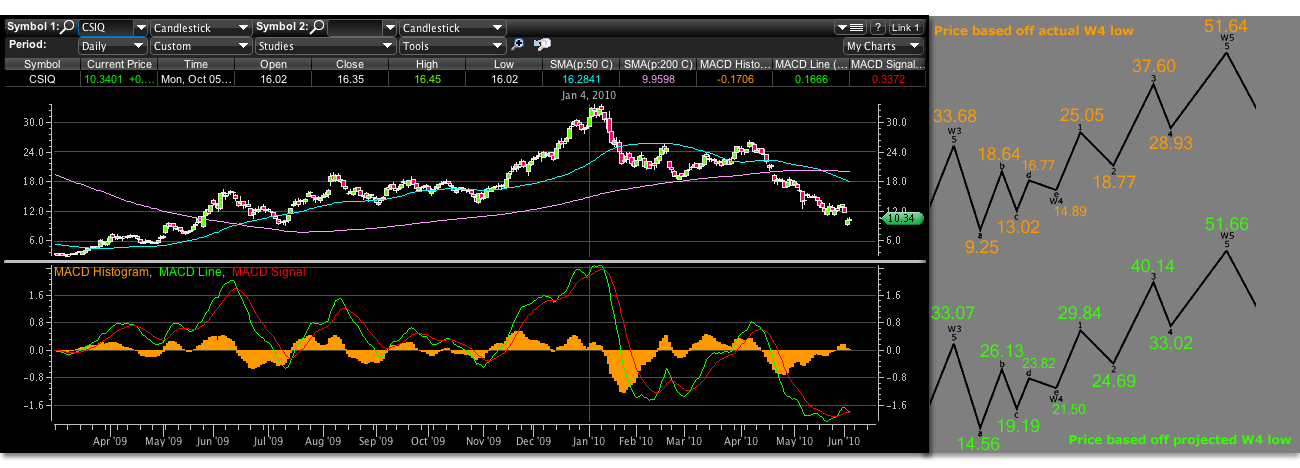
Canadian Solar has made a sharp correction in 2010 from a high of 33.68 to a low of 9.25 so far. This trading low could be very significant to a continuation of the trend higher. We outlined this trading level back in August of 2009. The 9.21 low was to be significant. The trading analysis done at that time was correct for the short term trade, yet this 9.21 support level was not an internal wave 4 low of wave 1 as stated. Looking at the price motion of CSIQ today, we can point out this error and also see where CSIQ might be trading next. The chart below shows an unmarked daily time frame from the March 2009 low.
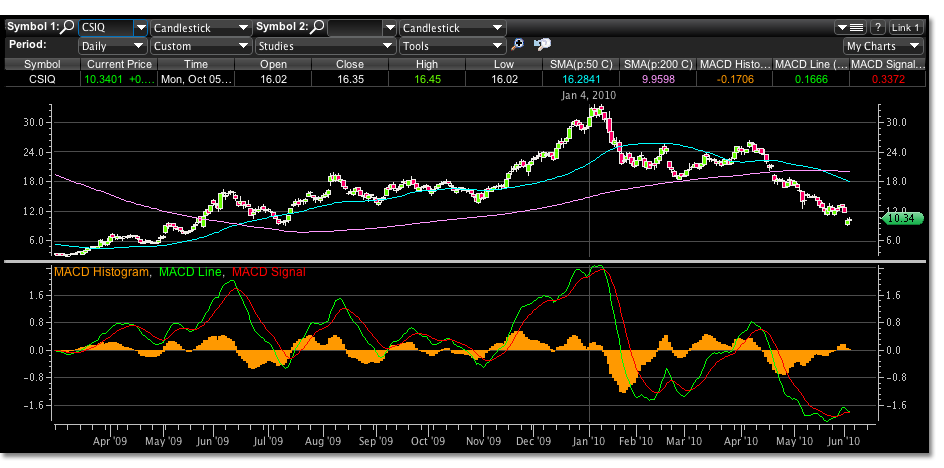
Initially the parent wave 1 calculation was being made from 3.00 March 9, 2009 low to 19.91 high on August 7, 2009. Although the macd daily time frame shows that the 19.91 high had divergence to a fifth wave top, this 19.91 price level was not in fact the parent wave 1 top but the internal wave 3 of parent wave 3. The trading that followed this 19.91 price was a flat correction internal wave 4 shown with the short horizontal red line in the chart below. This internal wave 4 traded to the mid 13.00 dollar range twice in an extended pattern before reaching the wave 5 of wave 3 parent target.
We can see now that the parent wave 3 is the 33.68 level by reading the largest wave in macd. This is verified by using the prior peak in macd on the daily time frame of 16.45 on 06/05/09 and calculating a wave 3 price target from this magnitude- you would get 33.074. This is in line with the latest high of 33.68 on 01/06/10.
Excluding the macd readings from the 19.91 price level to the present, this wave 1 price target of 16.45 appears to be a wave 3 of wave 1 macd because the time frame that is being used to view the macd is not detailed enough to show its divergence. As well, there is more lag in the larger time frames relative to the macd indicator and its smoothing mechanism will not always show this divergence at such a extended time frame. Using the mark up chart below illustrates apparent the technical levels in CSIQ.
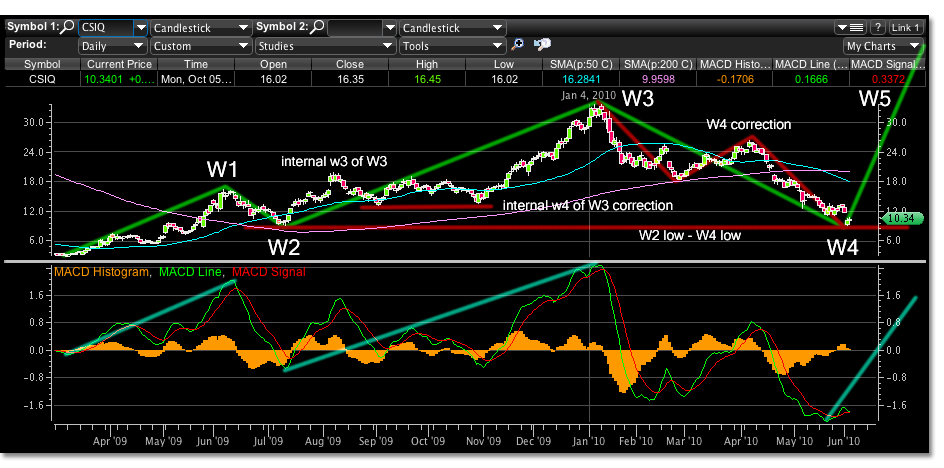
The latest move down from 33.68 on 01/06/10 must be the parent wave 4 of the uptrend. Wave 4 is dangerous for non committed bulls. Not only can it last for an extended period of time, but trading may reach the bottom of parent wave 2 depending on the magnitude of the expected correction with the trend still remaining intact.
Since we have calculated that the 16.45 price level was indeed the wave 1, the wave following this high was the 9.21 price low on 07/13/09 that we mentioned previously and becomes wave 2 low. So far CSIQ has kissed that price almost literally, trading to 9.25, and this sets up a very simple entry point and sell stop for a possible large move higher.
Because the wave 4 correction has extended itself so low in price, its price motion should follow the pattern of a triangle formation. In this case it would form its wave 1 of parent wave 5 price zero point at 38% of its corrected wave 3 magnitude. This price would be around 21.00 projected. This price is only used to project its future 5 wave price target of 51.00, not to be used as the lowest price entry.
A triangle formation can develop very slowly and then usually quickly breaks out towards its projected price target. Because CSIQ has extended so far lower than the projected triangle price, it could now create equally large swings in price as it rebalances from this move. Shorts could have covered most of there positions on the latest move to 9.25, but a retest of this level could occur and could be used to enter a trade with the 9.21 support level sell stop.
According to JPMorgan news flows yesterday June 2, 2010-“Canadian Solar (CSIQ) price target cut at Barclays to $11 from $22 as the company is under SEC investigation, delaying 1Q10 results. Maintain Equal Weight Rating.” This is reason to respect the price sell stop, understanding that unforeseen events may alter projections. This is also likely part of the reason for the extended sell off, along with a large short interest at the moment. However, this is exactly the sentiment that creates potential buying opportunities.
Projections in future price motion within a potential triangle formation can be gathered from the present and past data and could resemble the marked up illustration below. Often times projected and actual price targets are met with the same suspected alternations that corrective waves can exhibit. That being that these two charts may marry each others price targets in given situations depending on market volatility.